
Explore


Verticals we serve


Music Companies
Bandzoogle, Music Glue alternative.


Opticians
iLens, Mistral, VisionWeb alternative.


Real Estate Agencies
Whise, Sweepbright, Immoweb alternative.


Restaurants & Takeaways
Uber Eats & Takeaway commission alternative.
Services


Brand-Driven Product Strategy
Align product design with your brand's identity and goals.


UX & Design Systems
Build consistent, scalable, and user-friendly interfaces.


Development Support & Execution
Turn designs into real, high-quality digital products.


AI-Powered Workflows & Innovation
Use smart tools to move faster and reduce cost.


A Shelf Is Not an Ecosystem
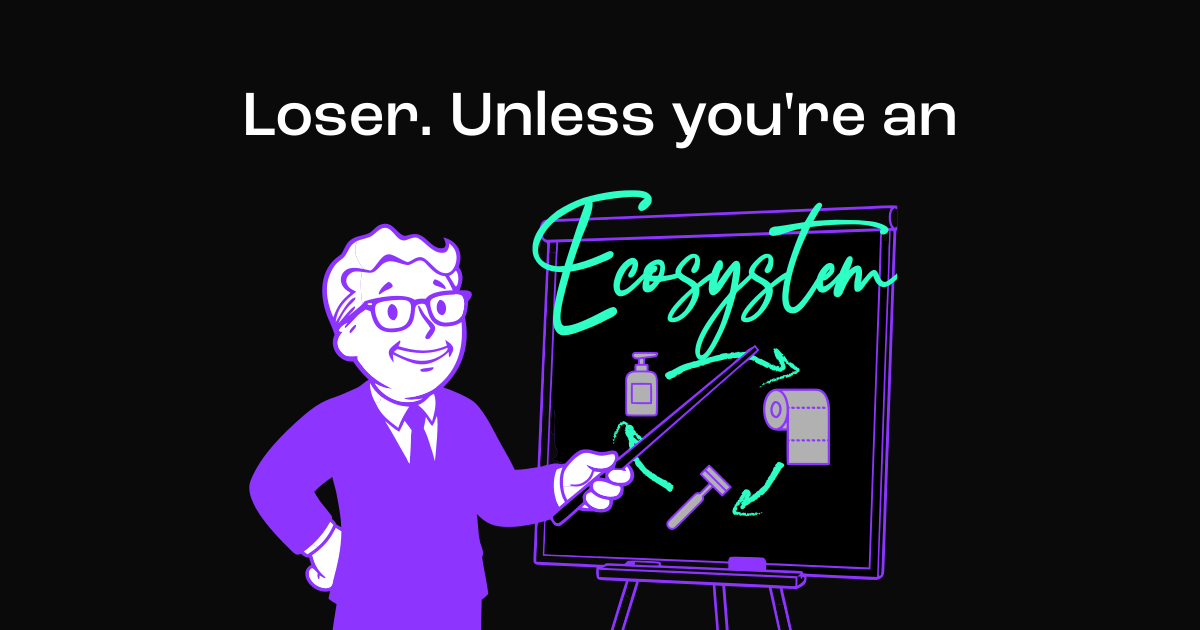
Soap. A razor. Toilet paper.
They live on the same shelf. They come from the same company. Someone drew arrows between them on a whiteboard.
Congratulations, you have an ecosystem.
You don't, obviously. But this is roughly the level of thinking behind half the companies using that word right now. Marketing found a shiny term, nobody checked what it meant, and now it's in the pitch deck.
What actually happened
I've been in the room for this. A financial company, a set of decent products, a new manager with a mandate to modernise. The rebrand arrived: one logo, all the product colours squeezed into a single mark, and a new line in the positioning.
We are an ecosystem now.
Nothing in the product changed. No shared identity, no shared data, no value moving between the parts. The colours got merged. That was the entire migration.
And nobody asked the obvious question, because the word sounded like winning.
The test takes four seconds
Does using one product make the others more valuable?
That's it. That's the whole thing.
Procter & Gamble owns Tide, Pampers and Gillette. Buying nappies gets you nothing on razors. Nobody there calls it an ecosystem, because it isn't one — it's a portfolio, and a phenomenally successful one.
Same with retail groups running supermarkets and fuel stations. Same owner, separate lives.
Now change one thing. Your groceries change what you pay at the pump. One account everywhere. What you fuel up on feeds what the shop offers you next week.
That's an ecosystem. Not the number of products. The absence of seams between them.
One integration is not a system
Here's the move I keep seeing, and it isn't lying. It's worse, because it's almost true.
A company has four products. Three of them live completely separate lives — own login, own audience, own roadmap. But one of them is genuinely embedded inside another. Real engineering, real value, shipped.
And then that one true connection gets promoted into a claim about the whole portfolio. We bring these domains together. Together how? One product built into another is an integration. It's a good thing. It is not a system.
An ecosystem is when connection is the default, not the exception you can point at in a press release.
So don't read the homepage. Count the seams. How many times does one user cross a login, re-enter the same data, export something to import it somewhere else, or explain to support that yes, it's all the same company? That number is your answer, and it doesn't care what's written on the wall.
Why I care about a word
Because the word is not decoration. It's a decision that other decisions get made from.
Call yourself an ecosystem and your designers start building flows across systems that don't share a database. Months of work go into a seamless surface glued over three separate logins.
Your leadership starts hunting for cross-product synergy in the numbers. It isn't there. Nothing connects, so nothing compounds. The conclusion drawn is usually our users don't cross over, when the truth is you never built them a way to.
And your users show up expecting one experience and get four passwords. That's not a messaging problem. That's the moment they stop believing you.
Meanwhile the company that honestly said we have a portfolio spent that year making each product better. They're fine. You spent it building bridges to nowhere.
Adobe is the cautionary tale
Adobe sells brilliant tools with files carried between them by hand. Export from Illustrator, open in Photoshop, upload a dead JPG to Behance, paste a link somewhere, collect feedback in a fourth place.
Every one of those steps is a seam. Every seam is where the work slows down.
Figma sells one space. Design, prototype, present, hand off, comment — same file, same link, same permissions. Nothing gets exported because nothing has to move. And animation is in demo right now, which quietly eats another product off that list.
People read this as browser versus desktop. It isn't. Local software isn't dying because it's local. It's dying because work stopped being something you do alone and then send. Feedback arrives while you're still working. Five people need the current version, not the one someone remembered to export.
Once that's how your users work, a product that can't join in loses. However good it is on its own.
The part nobody wants to hear
A portfolio grows by addition. Every new product starts from zero and stands alone.
An ecosystem compounds. Every new product makes everything already there worth more.
That gap doesn't close. It widens with every release. Which is why the speed that matters isn't how fast you ship — it's how fast the advantage stacks.
So: if you have a portfolio, say portfolio. Nothing wrong with it. Go make each product excellent.
But if you've written ecosystem on the wall and the architecture underneath is a shelf — you've made a promise you can't keep, and you'll spend years and a lot of money failing to keep it without ever quite working out why.
Which is why we built ours the other way round
ScoreSynth isn't five products sharing a logo. Audio goes in, a performable score comes out — transcription, arrangement, composition, editing and the score library all in the same place, in the browser, nothing to install.
Most of the market sells those pieces separately. A transcription tool here. A notation editor there. A sheet music library somewhere else, with a fourth account and a downloads folder holding it together.
We think that has the same future as the exported PSD. See what we built →
Ready to get started?
Build your site in 5 days — from €500.