
Explore


Products


Verticals we serve


Music Companies
Bandzoogle, Music Glue alternative.


Opticians
iLens, Mistral, VisionWeb alternative.


Real Estate Agencies
Whise, Sweepbright, Immoweb alternative.


Restaurants & Takeaways
Uber Eats & Takeaway commission alternative.
Services


Brand-Driven Product Strategy
Align product design with your brand's identity and goals.


UX & Design Systems
Build consistent, scalable, and user-friendly interfaces.


Development Support & Execution
Turn designs into real, high-quality digital products.


AI-Powered Workflows & Innovation
Use smart tools to move faster and reduce cost.


// Music Tech · Labels · Artists · Venues
Music software,
not music templates.
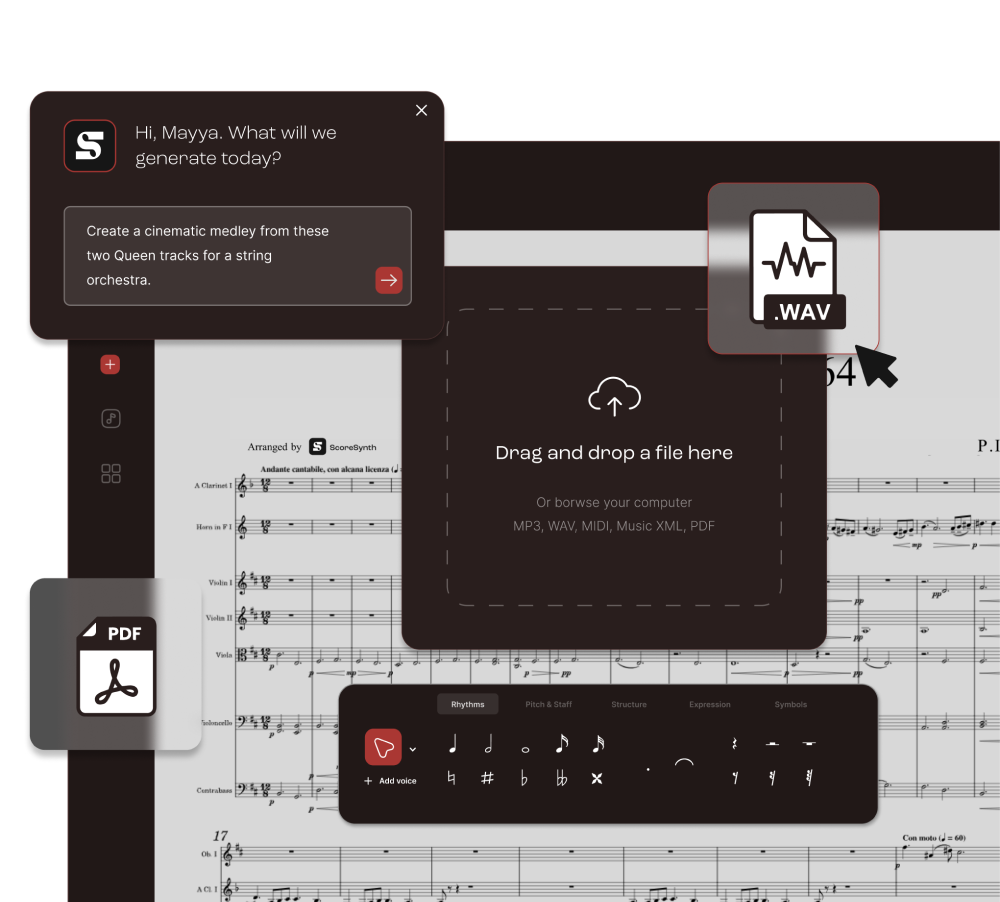
We do two things for the music industry. We build websites for artists, venues and labels — releases, programmes, tour dates, merch. And we build music applications: catalogue and licensing platforms, lesson and practice apps, audio tooling. We are the team behind ScoreSynth, which turns a recording into editable sheet music, so audio pipelines, notation rendering and rights metadata are not new territory. Spotify, Apple Music, Bandcamp and your distributor stay exactly where they are — they are distribution, not competition.
Sites for artists, venues and labels
The public face of a music project: a release that lands properly, a programme people can scan, a roster that is easy to browse. Built so you publish the next one yourself, without messaging anybody.
Typical price
€2,000 – €8,000
Timeline
3–6 weeks
Artist and band sites
A launch is a moment and the site should behave like one — countdown, pre-save, video, credits, tour dates and merch landing together instead of trickling out over a week.
Venue, club and festival sites
A programme people can actually scan, by date, room or genre, with the ticket flow embedded so nobody bounces to a third-party page mid-purchase. Lineups and recurring nights are set up once and reused.
Label and roster sites
Artists, releases, press and sync enquiries in one place, with release pages generated from the metadata your distributor already produces rather than typed out by hand.
Tour dates entered once
Add a show on your own site and it goes out to Bandsintown and Songkick from there. No more three versions of the same tour with one of them wrong.
Ownership
100% yours
Working language
English
Where
Remote worldwide

ScoreSynth
From a recording to editable sheet music.
ScoreSynth separates the parts, transcribes them and returns notation you can edit — exportable as MusicXML, MIDI or PDF. Building it meant solving audio processing, in-browser notation rendering, long-running jobs and large-file handling. Plenty of studios can style a template for a musician; far fewer have shipped an audio pipeline.
// PLATFORMS WE PLUG INTO
Your channels stay. All of them.
Streaming, distribution and ticketing are how music reaches people — we would never ask you to leave them. They keep doing what they are good at, and your own platform becomes the place where the audience actually belongs to you.
Streaming & distribution
Spotify
DISCOVERY ENGINE
Where people find the music and where the plays are counted. We pull catalogue and release data in, embed players properly, and send fans onward — the streams stay yours, the relationship becomes yours too.
Apple Music
DISCOVERY ENGINE
Same role, different audience. Release links, artist pages and pre-saves are generated from your catalogue automatically, so a new drop does not mean updating six places by hand.
Bandcamp
DIRECT SALES CHANNEL
Still the best place for a fan to buy music at a fair split, and it should keep that job. We link into it cleanly rather than trying to replace it — your site handles everything Bandcamp was never meant to do.
DistroKid
DISTRIBUTION
Releases go out through the distributor you already pay for — DistroKid, TuneCore, whichever. We read the metadata back (ISRC, UPC, release dates) so your catalogue page is right without anyone retyping it.
Live & ticketing
Bandsintown
TOUR LISTINGS
Dates entered once on your own site, then pushed out here rather than typed in twice. Fans following you on Bandsintown get the same tour everyone else sees.
Songkick
TOUR LISTINGS
The other half of live discovery, fed from the same place. One show added in one system, correct in all three — which is not where most artists start.
Eventbrite
TICKETING
Keep selling through whatever your venue or promoter already runs — Eventbrite, DICE, a local system. We embed the buying flow so fans never bounce mid-purchase, and listings stay in sync on their own.
Merch & payments
Shopify
YOUR MERCH BACK OFFICE
Inventory, fulfilment and shipping rules stay in Shopify, where they work. The storefront lives on your site and looks like your project rather than a generic shop theme.
Stripe
PAYMENTS
Subscriptions, licensing fees, lesson packages, pay-what-you-want — handled directly, with the money landing in your account and no platform taking a cut of every transaction.
// WHAT WE REPLACE
The layer between you and your audience.
Not the platforms above — the builder charging you monthly, or a cut of every sale, for a page you are not allowed to extend.
Bandzoogle
Fine site, hard ceiling
Genuinely built for musicians, and commission-free on merch — a reasonable first website. The ceiling arrives when you need something it does not have: a searchable catalogue, a members area, a gated preview flow, an actual product. You cannot add it, because you cannot touch the code.
$10–$20/mo
Music Glue
You pay per sale, forever
Bundles store, tickets and site together, which is convenient early on. The cost is structural: a cut of every sale for as long as you use it, and a fan database that lives in their system rather than yours. Grow, and the percentage quietly becomes your largest software bill.
Revenue share per sale
Squarespace
Beautiful, and generic
The templates look good — that is the point, and also the problem, because a hundred other acts picked the same one. Audio is a basic embed, there is no catalogue model behind it, and anything music-specific (stems, gated previews, licensing metadata) becomes a third-party plugin or a manual workaround.
$18–$45/mo + plugins
Wix
DIY template builder
Quick to launch and hard to grow out of. Performance degrades as the media library fills up, the audio player is whatever the widget offers, and there is no path from "website" to "product" — when you need an app, you start over somewhere else.
$18–$45/mo
WordPress (agency)
Plugin fatigue
Works on launch day. Then the audio plugin, the events plugin and the shop plugin each update on their own schedule, one breaks the others, and nobody on your team can publish a release without calling the agency that built it.
$500–$5,000 + maintenance
Linktree as a website
Rented, and unrankable
Perfect in a bio, and it should stay there. As your only web presence it means Google has nothing of yours to rank, you own no audience data, and every visitor is one tap away from leaving for someone else's platform. A link list is a signpost, not a home.
Free–$24/mo
// SOUND FAMILIAR
The signs you have outgrown the template.
Tick the ones that land. If three or more do, custom software is usually the honest answer. If none of them do, keep what you have — we will tell you so on the call.
Nothing ticked yet. If none of these are true, what you have is doing its job and we would rather tell you that.
Tell us what you want to build.
A 30-minute call, in English, no pitch. Bring a rough idea or a finished spec — we will tell you what it takes and what it costs, and whether we are the right people for it.
INDUSTRY FAQ
Questions, answered.
What music clients ask before they commit — pricing, ownership, and whether we can really do audio.
An artist or venue site with releases, tour dates and a proper audio player generally lands between €2,000 and €8,000 once. A label catalogue platform with search, rights metadata and private supervisor links is usually €8,000 to €20,000. A real product — a lesson app, a licensing marketplace, an AI audio tool — starts around €15,000 and scales with what it has to do. After launch you pay hosting, roughly €20–€60 a month, and no percentage of anything you sell.
No, and you should not. Streaming platforms are how people discover music, Bandcamp still gives artists the fairest direct split, and your distributor already handles delivery to every store. Those are channels, and channels are valuable. What we replace is the website builder sitting between you and your audience — the thing charging you monthly, or a cut per sale, for a page you cannot extend.
Both. ScoreSynth is our own product: it takes a recording, separates the parts, transcribes them and returns editable sheet music you can export as MusicXML, MIDI or PDF. Building it meant solving audio processing, notation rendering in the browser, long-running jobs and large-file handling. That work is the reason this page exists — most agencies serving musicians can style a template but have never shipped an audio pipeline.
Those are the right answer for a lot of artists, honestly — if you need a good-looking page with a store and nothing more, they are cheaper and faster than us. The difference shows up at the ceiling. When you need a searchable catalogue, a members area, a licensing flow or an actual application, a template builder cannot get there, and the work you put in does not transfer. We build the thing you own, in code you keep.
Yes — this is the one part of our work that is not local. We are based in Belgium and work remotely with music clients in the US, UK and across Europe. Calls run in English, mostly in the afternoon Central European Time so the US morning still works, and everything is delivered async in between. Contracts, invoicing and payment are in euros unless we agree otherwise.
You do, completely. The repository is transferred to you, the database is yours, and you can host it wherever you like. We are happy to keep maintaining it, but nothing is designed to trap you — no proprietary CMS you can only run through us, no fan list held hostage. If you ever want to walk away, you leave with the whole thing.
Yes. Ticketing usually stays with Eventbrite, DICE or whichever system your venue and promoter already use — we embed the purchase flow so fans complete it on your page. Merch typically stays in Shopify because inventory and fulfilment genuinely work there; we build the storefront so it looks like your project instead of a stock theme.
An artist or venue site is usually live in 3 to 6 weeks. A catalogue platform with search and rights metadata runs 6 to 12 weeks. A full application depends on scope, but we ship in stages rather than disappearing for six months — you see working software early and it grows from there. We design first, you approve every screen, then we build.